
Mighty Mule Gate Repair in Citrus Heights: A Homeowner’s Guide
Mighty Mule gate openers fail most often in Citrus Heights during December and January, and it rarely has anything to do with the gate itself. The solar charging system on these units loses up to 40% of its efficiency during Sacramento’s overcast winter weeks. The result is a battery that quietly dies, leaving homeowners convinced their opener is shot when the fix is often much simpler. If you’d rather not troubleshoot it yourself, call (877) 752-5078 and we’ll sort it out.
Why Mighty Mule Openers Are So Common in Citrus Heights
Drive through neighborhoods like Arcade Creek Estates, Sylvan Old Auburn Road, or the streets around San Juan Avenue and you’ll spot Mighty Mule systems on gates everywhere. The reason is simple: they’re the most DIY-friendly automatic gate opener on the market. Homeowners buy them at hardware stores for a few hundred dollars, watch a Saturday morning tutorial, and have a working automatic gate by Sunday afternoon. No electrician, no permits in most cases, no trenching wire from the house to the gate. That accessibility made Mighty Mule the default choice for a lot of Citrus Heights properties, especially on homes built before automatic gates were standard.
But that same simplicity comes with a design tradeoff that doesn’t show up until the rainy season. We’ll get into that below.
The Battery-First Design: What Makes Mighty Mule Different
Most gate operators on the market, including commercial-grade systems from LiftMaster, FAAC, and BFT, are hardwired. They pull 110-volt power directly from your home’s electrical panel to the operator. When the gate cycles open or closed, the motor draws from the grid. Simple, dependable, and the reason those systems run for a decade or more with basic maintenance.
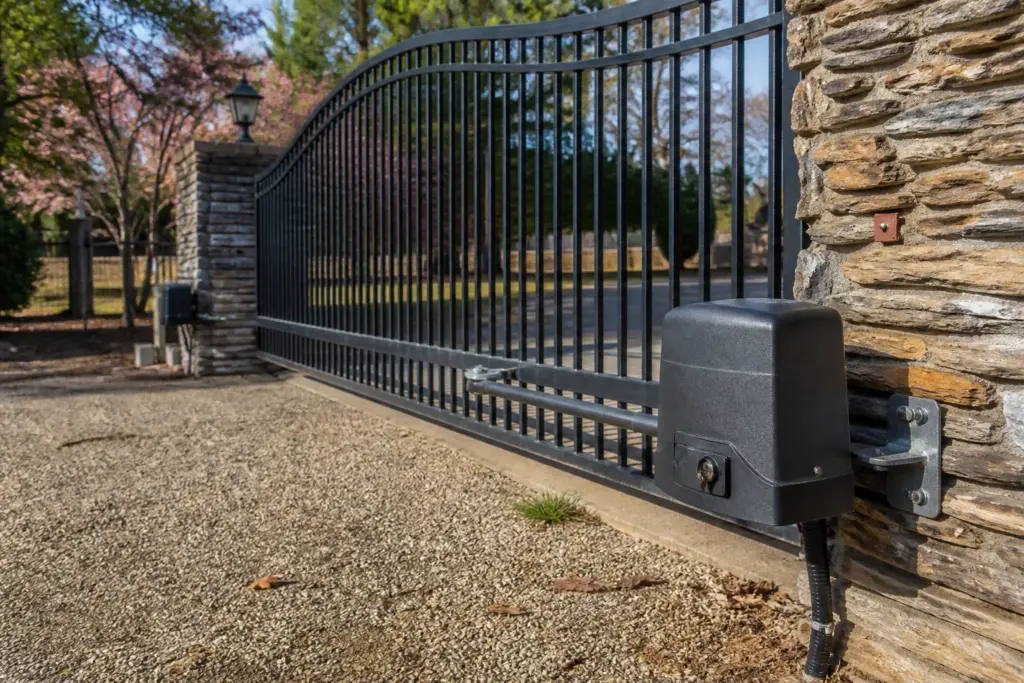
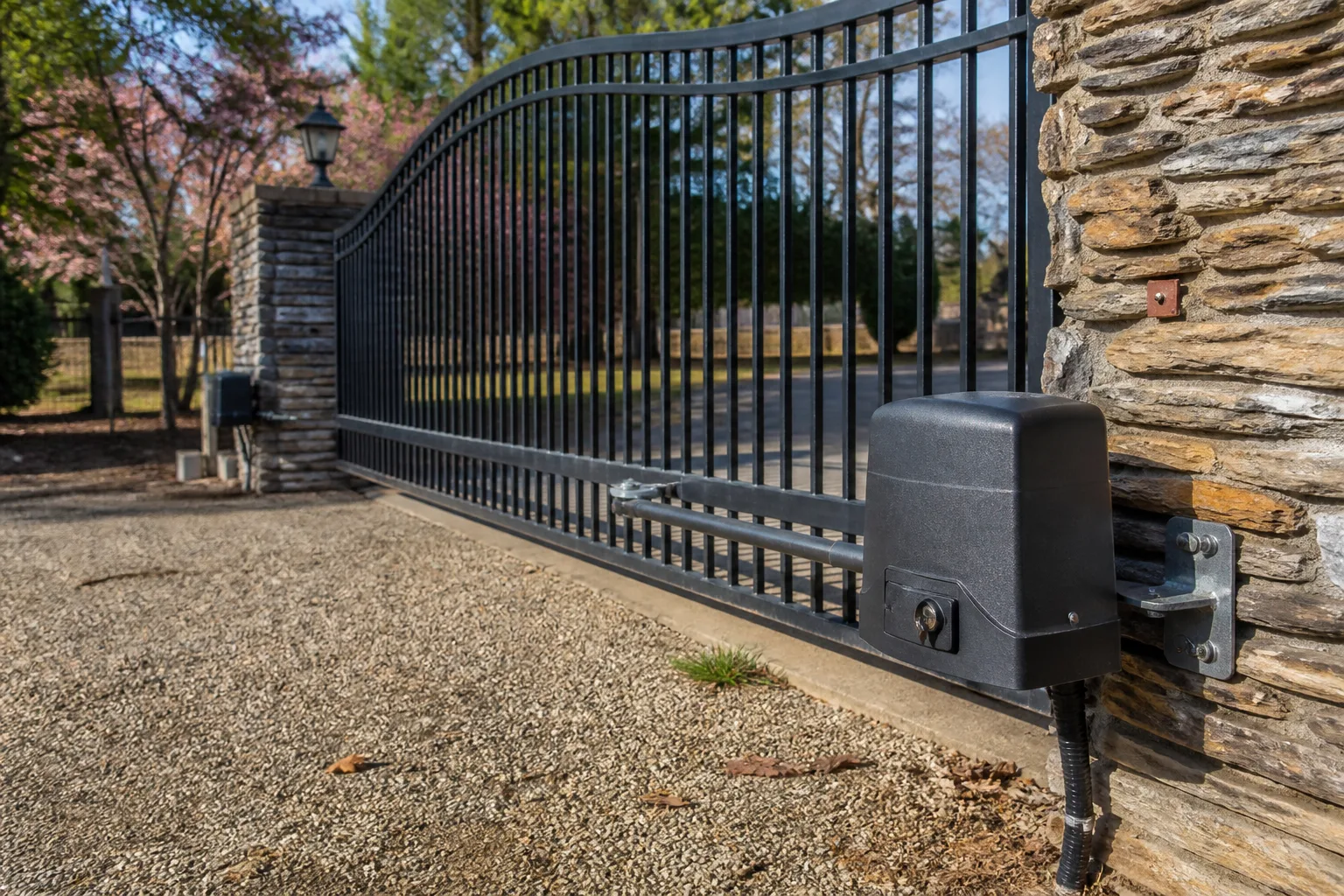
Mighty Mule takes a different approach. The FM500, FM502, and most other Mighty Mule models run on a 12-volt sealed lead-acid or lithium battery. That battery is recharged by a small solar panel mounted on or near the gate post, or through an optional AC trickle charger if you have an outlet nearby. The battery runs everything: the control board, the actuator arm, the receiver for your remote, and the safety sensors.
This architecture is wonderful if your gate sits too far from the house to run wire, or if you don’t want to dig a trench across your yard. The downside is that your entire gate system depends on a battery staying charged through Northern California’s winter. And Sacramento’s winter is exactly when the math stops working.
The December-January Problem
Mighty Mule’s own documentation assumes reasonable solar exposure. What it doesn’t account for is six to eight weeks of dense cloud cover between December and January. During those weeks, the solar panel might produce only 60% of its rated output. If your panel faces north, or sits under a tree that loses its leaves in fall but still blocks the low winter sun angle, the number drops further.
Meanwhile, the gate still cycles. Every open and close draws current. The control board draws a small idle current all day and night. Add in cooler temperatures, which reduce lead-acid battery performance by roughly 20% at 40°F, and you have a system that slowly bleeds down over several days until the control board hits its low-voltage cutoff and so the gate simply won’t move.
What Citrus Heights homeowners report in winter:
- Gate opens fine one day, dead the next morning.
- Slow operation with the actuator arm moving at half speed.
- Remote receiver works but the arm does nothing.
- Blinking red light on the control board that wasn’t there before.
That blinking red light is worth learning to read, because it tells you more than most people realize.
Reading the Blink Codes on FM500 and FM502 Models
Mighty Mule control boards include a diagnostic LED that flashes in patterns to indicate what is wrong. Knowing the difference between a two-blink pattern and a four-blink pattern can save you from replacing parts you don’t need. If you have a battery near the end of its life, the board may register a low-battery fault. If the board has a failed internal component, the code points elsewhere.
On the FM500 and FM502 specifically, the codes vary slightly by revision, so always cross-check the manual for your control board’s revision number. The general patterns we see in Citrus Heights service calls break down like this:
- Continuous fast blink: System is in setup or learn mode, or the board just powered up and is running a self-check.
- Two blinks, pause, repeat: Low battery voltage. This is the code we see most often in winter service calls.
- Three blinks: Limit switch error or the arm has moved past its programmed travel.
- Four blinks: Motor overcurrent. The arm is binding, the gear is stripped, or the gate is mechanically jammed.
One thing we’ve learned from hundreds of Mighty Mule calls: a two-blink code is often fixed with a battery replacement or a proper charge cycle, not a new control board. But if you replace the battery and the code returns within a week, the solar panel itself has likely degraded, and that is a different repair entirely.
Actuator Arm Failure vs. Stripped Drive Gear: Why the Cost Gap Matters
When a Mighty Mule opener fails to move the gate, there are two common mechanical culprits. They look identical from the outside, but the repair costs are not close.
The actuator arm failure. Mighty Mule uses a linear actuator inside a sealed housing. It has an internal electric motor, a worm gear, and a lead screw. When the actuator fails, the entire arm is typically replaced as a unit. This is the more expensive repair because the part itself is costly and installation involves removing the old arm, mounting the new one, and reprogramming the travel limits. Depending on where you source the replacement and who does the work, actuator replacement on a Mighty Mule system in Citrus Heights typically runs several hundred dollars in parts alone.
The stripped drive gear. Inside the actuator, and in some models at the point where the arm connects to the gate bracket, there is a plastic or composite gear designed to strip under excessive force. That is intentional. The gear acts as a sacrificial component so that the motor doesn’t burn itself out when a gate is pushed too hard by a person or slammed by wind. Replacing a stripped gear is far less expensive than replacing an actuator arm, often a small fraction of the cost. A competent repair shop can open the housing, swap the gear, regrease the assembly, and have the gate running the same afternoon.
The trick is telling them apart without opening the housing. Here’s the tell: if you press the remote and hear a whirring or grinding sound from the arm but the gate doesn’t move, the drive gear is likely stripped. If you press the remote and hear nothing at all, the motor inside the actuator has failed or the board isn’t sending power. That silence points to an actuator or electrical issue, not a gear.
We’ve lost count of how many Citrus Heights homeowners have paid for a full actuator replacement when a $15 gear was the real problem. Do yourself a favor and have someone who works on these daily take a look before writing off the arm.
When Mighty Mule’s Warranty Still Applies
Mighty Mule offers a limited warranty on their gate openers, but the specific terms matter more than most people realize. The warranty typically covers defects in materials and workmanship for a defined period from the date of purchase. On the FM500 and FM502, that period is limited, and it does not cover damage from improper installation, water intrusion, lightning, or use beyond the rated gate weight and length. It also does not cover the battery, which Mighty Mule classifies as a consumable part.
What Citrus Heights homeowners need for a valid warranty claim:
- Proof of purchase showing the original sale date (not the install date).
- Photos or documentation of the failure, including the blink code if present.
- The control board’s serial number and revision number.
- Installation details: gate length, gate weight, and whether the opener was installed per Mighty Mule’s included instructions.
If you did the install yourself and didn’t keep the receipt, the warranty is effectively void for all practical purposes. If you can’t confirm whether the gate weight and length are within the opener’s rating, expect the warranty process to be slow or denied. Keep a file. It matters.
Mighty Mule’s warranty does not transfer to a second owner. If you bought a house in Citrus Heights with an existing Mighty Mule system, the warranty ended when the original purchaser sold the property. That’s a detail most homeowners never learn until they need it.
The Upgrade Threshold: When to Stop Paying for Repairs
The oldest Mighty Mule systems in Citrus Heights are now 12 to 15 years old. Original batteries have been replaced multiple times. Solar panels are sun-faded and outputting a fraction of their original current. Control boards have survived heat waves and winter rains, and the plastic housings are getting brittle. At some point, continuing to repair an aging Mighty Mule stops making financial sense.
Here’s a practical way to think about it. If you’re looking at:
- A second battery replacement in three years, plus
- A solar panel that’s no longer keeping up, plus
- An actuator arm that’s showing signs of wear, plus
- Intermittent control board faults
Then you’re likely at or past the upgrade threshold. The combined cost of those repairs approaches what a hardwired operator from LiftMaster, FAAC, or Viking would cost installed, and the hardwired unit will run for the next decade with far less attention. Mighty Mule’s battery architecture made sense when you installed it. But once the system requires annual attention, it stops being the economical choice.
That said, a Mighty Mule opener that is only four or five years old and just needs a battery or a gear is almost always worth fixing. The repair is small, the unit has years left, and you know the system’s history. The threshold is about age plus accumulated failures. If you’re not sure where your system falls, have it evaluated before writing a check for either option.
When to Call a Gate Specialist
Some repairs are genuinely DIY-friendly, including battery swaps on Mighty Mule systems and gear replacements if you’re comfortable opening the actuator housing and have the right grease. But there are points where it’s not worth your weekend. If your gate is heavy, if the arm is under tension, or if you’ve diagnosed the problem and the repair requires reprogramming travel limits, call someone who does this daily. Our team at Gate Repair in Citrus Heights handles Mighty Mule systems weekly, and we also service comparable residential openers from Ghost Controls, which shares a similar design philosophy but with different internals.
How Gate Repair Citrus Heights Approaches Mighty Mule Work
We mention this briefly because we get calls about Mighty Mule systems from people who called three other shops first and were told to replace the whole opener. The reality is that most Mighty Mule problems are fixable with the right diagnostic approach. We work on nine major gate and operator brands, including Mighty Mule, LiftMaster, FAAC, BFT, Linear, Viking, Ghost Controls, DoorKing, and Elite. Every technician on our team works exclusively on gates. We don’t split time between garage doors, fencing, or general handyman work. Gates are the whole job.
For Mighty Mule specifically, which means we stock common Mighty Mule components, understand the blink-code system across multiple board revisions, and know when a unit is worth repairing versus when an Electric Gate Repair in Citrus Heights call should include a conversation about swapping to a hardwired system. If a replacement is the right answer, we also handle Gate Installation in Citrus Heights as a single-scope project, so homeowners and property managers aren’t coordinating two contractors.
One call covers repair or full installation. That’s the benefit of working with a shop that does nothing else.
Related Services in Citrus Heights
If your Mighty Mule turns out to be beyond saving, or if you’re considering an upgrade before the next winter drain cycle, our Gate Repair Citrus Heights home page covers the full picture of what we do, from manual gate fixes to automated systems.
The Bottom Line
Mighty Mule openers earned their popularity in Citrus Heights by being accessible. The same battery-first design that makes them easy to install is also what makes them vulnerable to Sacramento’s winter cloud cover, and that vulnerability shows up as dead batteries, slow gates, and blinking diagnostic codes that few homeowners know how to read. Before you replace a whole opener, check the blink code, check the battery, and have someone who knows the brand open the actuator before declaring the arm dead. A stripped gear is not an actuator failure, and a dead battery is not a control board issue. Knowing the difference can save hundreds.
If you’re in Citrus Heights and your Mighty Mule is giving you trouble, Gate Repair Citrus Heights offers free estimates. Call (877) 752-5078 and we’ll tell you exactly what’s wrong and what it costs before any work starts.
Frequently Asked Questions
Your Mighty Mule runs on a 12-volt battery recharged by a solar panel, and Sacramento’s December through January overcast weeks cut solar output by up to 40%. With less charge going in and the gate still cycling daily, the battery drains to the low-voltage cutoff and the opener stops responding. A battery replacement or a properly positioned AC trickle charger usually solves it. Call (877) 752-5078 if you want a winter-ready fix.
Most Mighty Mule repairs in Citrus Heights fall into a predictable range: battery replacement is the least expensive common fix, a stripped drive gear costs more in labor than parts, and a full actuator arm replacement is the priciest of the three. The exact number depends on what the blink code and inspection reveal. We quote every price before work starts, so call (877) 752-5078 for a free estimate.
Many Mighty Mule repairs in Citrus Heights are same-day jobs once we diagnose the issue. Battery swaps, gear replacements, and limit switch adjustments are typically quick. If a custom actuator arm has to be ordered, that adds lead time. Call (877) 752-5078 and we’ll tell you what’s realistic for your specific model and problem.
If your Mighty Mule is five years old or less and needs a battery or gear, repair makes sense. If it’s over ten years old, has had multiple battery replacements, and the solar panel is fading, you’re likely at the point where a hardwired operator from LiftMaster, FAAC, or Viking costs about the same as continued repairs over the next few years. We can evaluate your existing system and give you honest numbers for both options. Call (877) 752-5078.
Written by the team at Gate Repair Citrus Heights, serving Citrus Heights since 2018.
Need Gate Repair Help?
Call Gate Repair Citrus Heights - licensed & insured, here with fast help in Citrus Heights.
(877) 752-5078